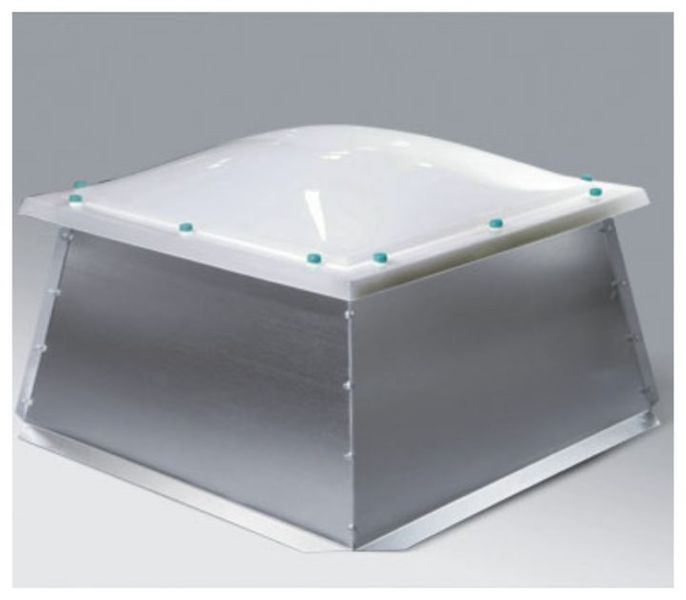
AWAK anti-aircraft lights manufactured by the Polish company Icopal fully comply with European and Russian standards and regulations. The products have received the European CE Certificate of Conformity.
Main functions of AWAK anti-aircraft lights
- Illumination
- Airing - Smoke removal
Classification of anti-aircraft lights by their purpose
- Deaf (light). Perform the function of additional lighting.
- Opening anti-aircraft skylights with natural light and ventilation functions.
- Smoke exhaust hatches serve as an additional source of daylight, remove smoke in case of fire or fire, and provide access to the roof during rescue operations.
There are different types of anti-aircraft lights according to their construction:
-Point lights;
-Strip lights (light belts).
Light-transmitting filling
Affects the appearance and characteristics of skylights (smoke hatches): light transmission, thermal insulation ability. Smoke hatches and skylights are manufactured with light-transmitting polycarbonate or acrylic glazing. They are installed on roofs with a slope of up to 15%, made using rolled polymer, bitumen or bitumen-polymer materials and corrugated board.
The following materials are used to make the filling:
- single-layer or multi-layer acrylic (up to 3 layers);
- cellular polycarbonate with a thickness of 10, 16, 20 mm.
For double-leaf hatches and anti-aircraft skylights (strip structures), only polycarbonate filling is used.
Types of light transmission of the dome:
- acrylic (transparent, frosted);
- polycarbonate (transparent, frosted).
The ability of the material filling the dome of the anti-aircraft light (hatch) to transmit daylight is calculated by the % light transmission coefficient, based on the type of material, thickness, type.
3 types of opening of anti-aircraft gunports (hatches):
- manual
- pneumatic;
- electric.
Depending on the purpose of the application and the load, the drive can be adjusted. For industrial facilities, public buildings, as a rule, a system with electric drives, an automatic operation control panel and a ventilation function is installed. According to the project.
Although, a pneumatic system is more reliable and cheaper than an electrically activated system.
Design of the skylight (roof hatch)
- Base
- Frame
- Light-transmitting filling
- Sealing frame
- Actuators
- Vapour barrier
- Thermal insulation layer
- Waterproofing carpet
- Additional equipment (deflectors, protective grilles).
Additional equipment
- Deflectors. Increase the effective area for smoke removal, prevent wind from blowing under the support frame when closed. Installed on smoke hatches (according to the project). They are made of aluminium or galvanised steel.
- Protective grilles. Create safety by closing the opening on the roof, preventing accidental falls. They are installed in special protrusions (slots) in the lower part of the base. They are made of galvanised metal U-shaped profiles.
Areas of application for anti-aircraft skylights (smoke exhaust hatches)
- Industrial facilities: production and repair shops.
- Public buildings: administrative, educational, cultural and entertainment, shopping and business centres, museums, shops.
- Warehouses: logistics centres, heated warehouses with special storage requirements.
- Sports facilities: swimming pools, indoor stadiums, sports complexes, children's and youth sports schools, arenas, arenas.
- Bus stations, railway stations, airports.
- Residential buildings.
Favourable advantages of installing AWAK anti-aircraft lights by the Polish company ICOPAL
- A rational solution to the problem of natural daylighting and ventilation of premises under construction or reconstruction.
- They comply with the building rules and regulations of DSTU EN, have passed fire tests and have certificates of conformity.
- They contribute to energy saving.
- Provide a high level of fire safety.
- They help to create the right microclimate in buildings and structures: illumination, temperature, humidity, ventilation, thereby increasing the productivity of workers.
- They eliminate the use of an organised natural ventilation system (air ducts), which simplifies and reduces the cost of the engineering system of large buildings.
Inspection
Skylights (hatches) should be periodically inspected by specialists at least 2 times a year (in spring and autumn) to check the condition of the light-transmitting filling, sealing gaskets, the operability of the drives, and carry out the necessary repairs. In winter, control the snow load and carry out cleaning.